
Product added to cart
Bicycle chain lubricants
Bicycle chain lubricants for every condition: dry for summer and road, wet for rain and mud, wax where the lowest drivetrain wear matters most. If you are torn between wax and oil, the comparison is below the product list.
- Lubes & Sealant BundleSpecial Price €41.00 Regular Price €56.00Min. 30 days: €41.00Maximum drivetrain performance
- Cleaner & Lube BundleSpecial Price €30.00 Regular Price €44.75Min. 30 days: €30.00Complete drivetrain care for every weather condition
- Drivetrain BundleSpecial Price €33.00 Regular Price €44.00Min. 30 days: €33.00Clean drivetrain, sealed tyres
- Bicycle Must Have BundleSpecial Price €32.00 Regular Price €42.75Min. 30 days: €31.75Clean bicycle, efficient drivetrain
-
-
-
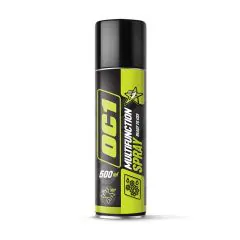
- OC1 Multifunction Spray 500ml€15.00€3.00/100 mlLubricates, protects against rust and displaces moisture.
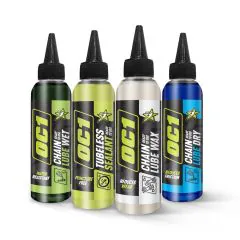
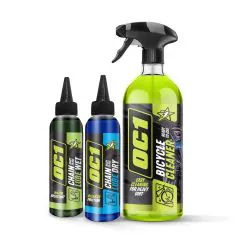
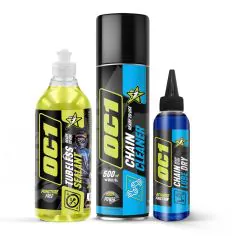
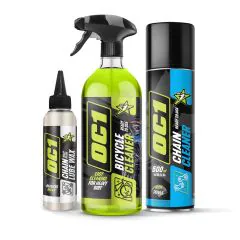
Wax or wet lube — which should you choose?
This is the most common question in this category and there is no single answer. The difference comes down to what matters more to you: a clean drivetrain or resistance to water.
Wax penetrates the links and sets into a dry coating. It is not tacky, so it does not collect dust — the chain stays clean, and so do your calf and socks. You pay for that with more frequent reapplication, because wax washes off faster in the rain.
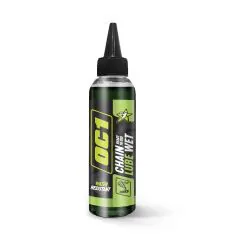
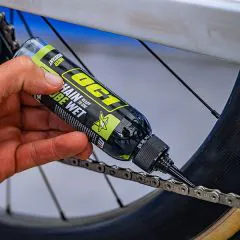
Wet lube is thick and adhesive. It stays on the chain through long rides in streaming water, but for the same reason it sticks sand and dust to itself. The drivetrain needs cleaning more often.
In practice: mostly dry riding and you care about cleanliness — wax. Riding all year, autumn and winter included — wet lube. Plenty of cyclists simply keep both and switch with the season.
Which lubricant suits which conditions?
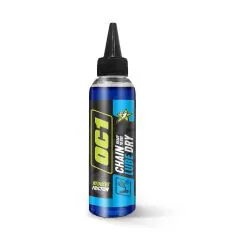
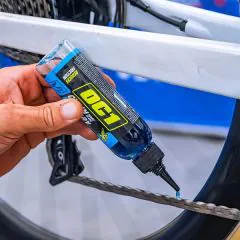
Dry and dusty — road, gravel in summer, sandy trails. OC1 Chain Lube Dry soaks into the links and leaves a thin layer that does not attract dust.
Wet and muddy — rain, autumn, winter, forest. OC1 Chain Lube Wet does not wash off and protects against corrosion.
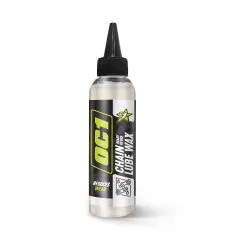
Maximum efficiency — OC1 Chain Lube Wax. Wax lubricants cut chain wear by over 80% compared with running unlubricated. The choice for road, gravel and XC.
How often should you lubricate the chain?
In dry conditions every 150–200 km, or every 2–3 weeks of regular riding, is enough. In mud and rain — after every outing.
The best indicator is sound. A quiet drivetrain means everything is in order. A dry rustle or a grinding note means the lubricant has run out, and that every further kilometre is now costing you cassette wear.
Lubricating after every wash is compulsory. Water flushes lubricant out of the links more effectively than anything else.
How should lubricant be applied?
The rule runs against intuition: less is more. Lubricant belongs inside the chain, not on the outside.
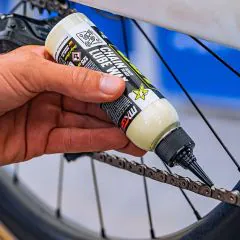
Hold the bottle nozzle over the rollers and turn the cranks backwards, applying one drop per roller. For an 11- or 12-speed chain that is around 116 drops and about two minutes of work.
Then turn the pedals for half a minute so the lubricant spreads through the gaps, and wipe off the excess with a clean cloth. This is the step most often skipped and the one that decides the outcome — anything left on the outside turns into black sludge that collects sand.
⚠ Only ever lubricate a clean chain. Fresh lubricant on old dirt forms an abrasive paste that destroys the drivetrain faster than no lubricant at all. OC1 Chain Cleaner handles the degreasing.
⚠ WD-40 is not a chain lubricant. It is a water-displacing product — it evaporates and leaves bare metal.
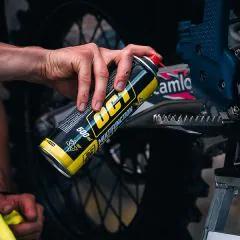
For seized bolts, cables and hinges, a multi-purpose spray comes in useful. Full drivetrain guide: cleaning and lubricating a bicycle chain.