Product added to cart
A textile motorcycle jacket and trousers work in tough conditions. After a few rides, insect residue builds up on the front, a grey film from exhaust fumes settles on the legs and back, and after riding in the rain, streaks of road dust appear. Putting off cleaning motorcycle clothing lets the dirt work deeper into the fabric, making it harder to remove later.
Technical clothing is not ordinary clothing. The membrane, seam tape, protectors and waterproofing call for a different approach than a cotton hoodie. Most of the dirt from a ride can be removed locally, though, without washing, and a full wash - done the right way - is needed only a few times a season.
Dirt on motorcycle clothing differs from everyday stains. Insect residue contains proteins that harden as they dry and stick firmly to the fibres. Exhaust deposits and oil droplets thrown up from the road surface are greasy, so water alone does not dissolve them. Rain sprayed up from the wheels carries dust, oil and road salt, and leaves distinct rings once it evaporates.
| Type of dirt | Where it appears | When to remove it |
|---|---|---|
| Insects | chest, shoulders, knees | after every ride, before it dries |
| Exhaust deposits | legs, back, seat of the trousers | at the first sign of a grey film |
| Rain streaks | front of the jacket, legs | once the clothing has dried |
| Mud and dust | bottom of the trousers, sleeves | once dry, with a brush first |
Regular cleaning matters for more than looks. Dirty reflective elements reflect light less well, and a greasy film on the surface weakens the waterproofing - instead of running off, water soaks into the outer layer of the fabric.
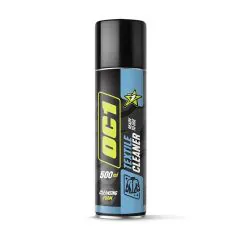
Spot cleaning means removing specific stains without soaking the whole garment. It works after most rides: for insects, exhaust deposits and rain streaks. For everyday riding, the manufacturer of OC1 Textile Cleaner recommends cleaning every few days, ideally straight after rain, mud or a long ride. On longer trips, described in the article on adventure touring motorcycles, washing is often impossible, while an aerosol foam fits in a pannier.
A full wash is needed when the clothing is sweaty, dirty over a large area or about to be stored after the season. The smell of sweaty clothing and ways to neutralise it are described in the guide on how to get rid of odour in motorcycle gear. Insects also cover the helmet visor, and how to remove them safely is described in the guide on how to clean a motorcycle visor without scratches or streaks.
Before washing a jacket or trousers with a membrane, it is worth reading the care label, because the recommendations vary depending on the manufacturer and the design. The general rules are as follows:
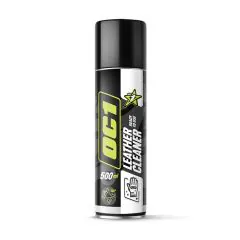
The product itself has limitations too. OC1 Textile Cleaner is designed for technical fabrics, including those with a membrane, because according to the manufacturer it does not clog the pores or reduce breathability. It works on jackets, trousers, gloves, textile boots and protectors, as well as cycling clothing. It is not used on wool, silk or natural leather, however - OC1 Leather Cleaner is designed for leather jackets, and the rules for looking after them are described in the guide on how to care for motorcycle leather.
The procedure below covers spot cleaning and follows the OC1 Textile Cleaner manufacturer's instructions.
The jacket and trousers should cool down after the ride, because the product is not applied to hot surfaces. Loose dust and dried mud are removed by hand or with a dry brush. On light-coloured or unusual fabrics, a test in an inconspicuous spot is recommended.
The can should be shaken, and the foam then applied to the dirty areas from a distance of about 15–20 cm. There is no need to soak the whole garment - the product works on the spot. The recommended temperature range is 5–25 °C.
The foam needs about 2 minutes to dissolve the dirt. The fabric is then wiped with a clean, dry cloth or sponge, without scrubbing. Stubborn stains can be rubbed gently with a sponge, and with heavy dirt the application is repeated once the fabric has dried.
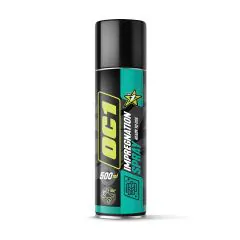
The fabric usually dries in 5–15 minutes, depending on its thickness and the ambient temperature. Clean, dry clothing is worth waterproofing, for example with OC1 Impregnation Spray, which renews the layer that repels water and dirt.
OC1 Textile Cleaner is an extremely flammable pressurised aerosol that irritates the eyes. It is used outdoors or in a well-ventilated room, away from naked flames and sources of ignition, without breathing in the spray mist. The can must not be pierced or burnt, even when empty, or exposed to temperatures above 50 °C - so it should not be left in a car in summer. Leftover product is not poured down the drain.
Most damage to textile clothing comes from a few recurring mistakes:
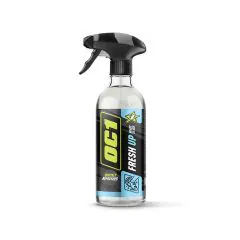
OC1 Textile Cleaner is a 500 ml aerosol foam made in Germany, designed for motorcycle clothing and other textiles, including car upholstery. Its strong dissolving properties let it remove exhaust deposits, rain streaks and insect residue; it dries quickly and leaves a delicate scent. For freshening up sweaty gloves or a helmet liner, the manufacturer recommends the OC1 Fresh Up freshener instead.
Below are answers to the questions that often come up when looking after textile clothing.
Insects are best removed as soon as possible after the ride, before they dry. Textile cleaning foam is applied to the marks, left for about 2 minutes and the fabric wiped with a clean cloth. It is better not to use a hard brush, as it can damage the fabric's coating.
Many models can be machine washed, but the manufacturer's care label always decides. Manufacturers usually recommend a low temperature, a delicate cycle, a detergent for technical clothing and taking the protectors out first.
Spot cleaning is worth doing every few days with everyday riding and after every ride in rain or mud. A full wash is needed a few times a season and before winter storage.
Regular cleaning of motorcycle clothing rests on a simple principle: dirt is removed locally and as you go, and a full wash is done less often, according to the care label and with the protectors taken out. This approach protects the membrane, seams and waterproofing, and the clothing keeps its looks and properties for longer.
OC1 Textile Cleaner removes insects, exhaust deposits and rain streaks without washing or scrubbing, and within a quarter of an hour the jacket is ready to ride or to be waterproofed.