Product added to cart
How to Care for Your Motorcycle Helmet? A Full Guide

The helmet is the only piece of motorcycling equipment that can genuinely save your life. One can survive a crash without armour or jackets, but without a helmet the statistics are unforgiving. That's why caring for this piece of polycarbonate, fibreglass or carbon fibre isn't the obsession of a perfectionist — it's an investment in safety and comfort on every ride.
The problem is that most motorcyclists treat their helmet as an indestructible artefact. They stuff wet gloves inside, wipe the visor with whatever comes to hand, store it in the garage hanging from the handlebars, then wonder why after a season it smells like an old dishcloth and the visor looks as though someone polished it with sandpaper. This guide covers all aspects of helmet maintenance — from daily cleaning to proper storage — so it serves you as long and as well as possible.
Helmet construction — what you're cleaning and why
To properly care for a helmet, it's worth understanding what it's made of and how individual components react to various factors. The outer shell is the first line of defence — made from polycarbonate (budget models), fibreglass composite (mid-range) or carbon fibre (premium models). Each of these materials has different properties and reacts differently to cleaning agents.
Beneath the shell lies the impact-absorbing layer, typically expanded polystyrene (EPS). This disperses impact energy and protects the brain. It's single-use — after a significant impact, the helmet requires replacement, even if it looks fine externally. The interior comprises the comfort liner, which contacts the head and collects sweat, skin oils and dust. In better helmets, it's removable and washable. In cheaper ones, it's permanently glued and requires different cleaning methods.
The visor is a separate matter — made from polycarbonate or PMMA, often with anti-fog, UV or photochromic coatings. Each of these coatings requires gentle handling, as they're easily damaged by the wrong cleaning product or a coarse cloth. Ventilation mechanisms, chin straps and closures are frequently overlooked elements, yet their cleanliness and proper function also affect comfort and safety.
Cleaning the outer shell — gentleness and regularity
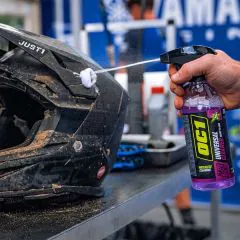
After every ride, insects, dust, mud, asphalt grit and in urban areas — soot — accumulate on the shell. Most of this can be removed with a damp microfibre cloth without any products. The key is regularity — fresh contamination comes off easily; insects dried on for a week require force and risk scratching.
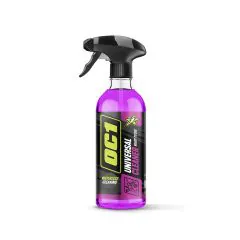
When water alone isn't sufficient, OC1 Universal Cleaner comes in — a formula without aggressive detergents that removes stubborn dirt without attacking the paint or graphics. Spray the contamination, wait a moment, wipe with a soft cloth. No scrubbing, no force. Most issues with dulled paint or scratches stem precisely from scrubbing dried-on contamination.
Never use washing-up liquid, glass cleaners or aggressive solvents. These can weaken polycarbonate structure, damage paint or dissolve adhesives bonding different helmet layers. In the worst case, the helmet may lose its homologation and cease to protect in an accident, even if it looks fine visually.
Details such as ventilation slots and areas around the visor mechanism collect dirt particularly intensively. A soft brush (even an ordinary toothbrush) helps remove dust and sand from hard-to-reach places. After cleaning, it's worth wiping everything dry — moisture left in crevices can lead to corrosion of metal components.
Helmet interior — combating sweat and odour
This is where most activity occurs. Sweat, sebum from the scalp, remnants of hair gel or mousse — all of this ends up in the liner. After intensive riding on a warm day, the helmet interior can be thoroughly soaked. If you don't clean this, bacteria begin their work and after a few weeks you have a helmet nobody wants to smell.
Helmets with removable liners are straightforward — following the manufacturer's instructions, detach the elements and hand-wash in lukewarm water with mild detergent. Don't put them in the washing machine, don't use hot water, don't dry on a radiator or in direct sunlight — materials may shrink or lose their properties. After rinsing, gently squeeze (don't wring) and dry in a well-ventilated area. Some add a drop of fabric conditioner for a fresh scent, but use caution — too much can cause the liner to become slippery.
Helmets with non-removable liners require more effort. A damp microfibre cloth and mild soap solution form the foundation. Wipe, rinse the cloth, wipe again until the water runs clean. The key is removing as much detergent as possible with clean water — residual soap irritates the skin. Some use antibacterial products, but exercise caution with chemicals that will contact your scalp for many hours.
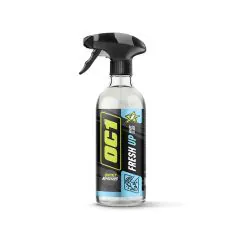
Odour neutralisation is a separate topic. Cleanliness alone doesn't always suffice, as bacteria may have already established themselves deep within the foam. OC1 Anti-Fog contains odour-neutralising ingredients in its formula — a light spray inside and leaving to dry often resolves the issue. Other methods include sachets of bicarbonate of soda left in the helmet overnight or specialist antibacterial inserts.
Visor and lenses — clarity means safety
A dirty or scratched visor isn't merely an aesthetic issue — it's a genuine safety hazard. Smears, contamination or scratches scatter light from oncoming headlamps in the evening and can effectively dazzle you for a fraction of a second. That's why the visor should always be perfectly clean.
After every ride, the foundation is a damp microfibre cloth and water. Don't wipe dry — grains of sand or dust act like sandpaper. First moisten and rinse, then gently wipe. Insects are enemy number one — left in sunlight they dry so thoroughly they practically bond with the plastic. A wet paper towel placed on the visor for several minutes softens the contamination so it can be safely removed.
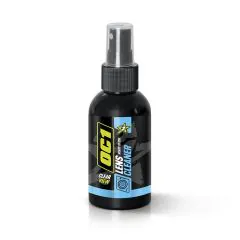
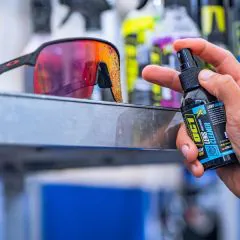
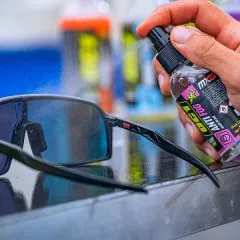
For stubborn contamination, OC1 Lens Cleaner serves the purpose — a specialist formula safe for all types of coatings found on modern visors. It leaves no streaks, dries quickly and damages neither UV coatings, nor anti-reflective, nor photochromic ones. Spray, wait a moment, wipe with a soft cloth from centre outwards. No circular motions, no force.
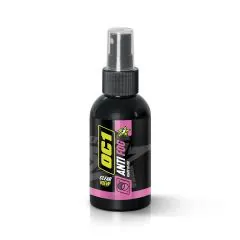
Visor fogging is a particular problem on cooler days or during rain. Most contemporary helmets have Pinlock systems or similar, but these also require maintenance. Regular application of OC1 Anti-Fog on the visor's inner surface creates a microscopic coating that prevents water vapour condensation. Apply a thin layer, rub until dry, done. The effect lasts several rides before reapplication is needed.
Storage and transport — details that matter
Where and how you keep your helmet between rides significantly affects its lifespan. The worst thing you can do is leave it on the handlebars or mirrors. Sunlight damages polycarbonate and composites, rain gets into the interior, and a hanging helmet deforms the liner. After a few weeks of such treatment, the helmet loses proper fit, which means reduced safety.
Ideally, store in a cool, dry place away from direct light. A helmet bag protects against dust and accidental scratches. If the helmet is wet after riding in rain, first dry it in a well-ventilated area, then store. Moisture trapped in a bag creates ideal conditions for mould.
Never store anything inside the helmet — neither gloves, nor a scarf, nor any other items. Damp, dirty gloves are a bacterial bomb. Additionally, they deform the liner and may leave stains from fuel or oil you touched at the petrol station. The helmet should be empty, dry and clean.
Transport is another matter. Hanging the helmet on your elbow or holding it by the chin strap stresses the mechanisms and can damage them. This isn't covered by warranty, as manufacturers assume the helmet is worn on the head or held by the inner shell (where the head goes). Invest in a proper bag with a handle — it protects the helmet and is convenient.
When should you replace a helmet?
Even the best-maintained helmet has a limited lifespan. Manufacturers typically recommend replacement after five years from the date of manufacture (not purchase), regardless of usage intensity. Materials age — UV damages polycarbonate, adhesives lose their properties, EPS foam undergoes natural degradation processes. After five years, a helmet may look excellent but no longer guarantees full protection.
Naturally, any forceful impact means automatic replacement. Even if you see no damage, the absorbing layer may have compressed and won't function properly upon subsequent impact. Some companies offer crash replacement programmes — you return the damaged helmet and receive a discount on a new one. Worth investigating.
Visible cracks, shell deformations, loose visor mountings or damaged straps are obvious signals for replacement. Equally important is fit — if the liner has worn and the helmet has become loose, it ceases to protect properly. This cannot be remedied by adding foam inserts — that's not how it works.
Summary
The helmet is every motorcyclist's most important investment and deserves proper care. Regular external and internal cleaning, proper visor maintenance, appropriate storage and transport, and awareness of when replacement time arrives — all this constitutes a responsible approach to equipment that can save your life.
OC1 Universal Cleaner removes dirt from the outer shell without risk of damage, OC1 Lens Cleaner ensures perfect visor clarity, and OC1 Anti-Fog prevents fogging whilst neutralising unpleasant odours. It's a simple product range that covers all motorcycle helmet maintenance needs.